How much of writing is remorse? How many of the things you publish & post online are symbols of the things you didn't? How much of it is about who you are vs. who you really want to be? How many of the line breaks are arbitrary? How much is written between the lines? How bad for yourself can you feel before you realize that you have it pretty good? How good can you feel before things start turning sour? How much are you allowed to write before realizing that maybe you don't have all that much to say at all?
And that maybe, that's okay?
Monday, April 15, 2013


Sunday, March 17, 2013
Why Tomb Raider is the best game you'll play this year
Two weeks ago, I was fairly certain I wasn't going to pick up Tomb Raider, Crystal Dynamics' latest in a series nearly two decades running. I wasn't particularly fond of what I could remember of the over-sexualized crypt crawler, whose greatest feat seemed to be squeezing her impossible somatotype through dark, cramped corridors. Plus, the game looked to be going the way of so many soulless big-budget titles these days, featuring series after series of flashy real time events, as if all any of any of us are looking for in our games are prompts to hit the right button at the right time.
However, hearing a few good things from a few trusted friends, I decided to give the game a try, and goddamn am I glad I did. Tomb Raider has it's numerous real time events, and Lara is still rather, well, robust (though looking less like a pistol-wielding Barbie this time around and more like an actual human); however, Tomb Raider offers one of the better examples of smart gameplay and character development available in the market right now.


However, hearing a few good things from a few trusted friends, I decided to give the game a try, and goddamn am I glad I did. Tomb Raider has it's numerous real time events, and Lara is still rather, well, robust (though looking less like a pistol-wielding Barbie this time around and more like an actual human); however, Tomb Raider offers one of the better examples of smart gameplay and character development available in the market right now.

The tagline for the series is "a survivor is born," but it might as well be, "a series is resurrected." Look out Lazarus - Lara Croft is providing some serious competition in the miraculous return department.
MASH THE 'E' KEY
Let's start with the real time events (RTEs). For anyone reading who isn't familiar with the current state of games, RTEs are a gameplay mechanic used to offer a more cinematic experience for certain game moments. Because games traditionally offer a suite of controls and skills that the player can utilize as they see fit, the game space hasn't always allowed directors to employ wildly varying camera angles, actions, or events - any of these things thrown into the mix without warning could compromise the experience for the player, especially if they're expected to complete a complex set of actions with the camera zoomed in a foot away from the protagonist's face, for example. RTEs solve that by prompting the player to complete just one or two things at a time, allowing developers to showcase stunning special effects without compromising the player experience.
At it's best, this mechanic can break up game pacing and offer a fresh and exciting moment in the narrative/combat/exploration for a given scene; at it's worst, this mechanic can make a game feel overly contrived, simplistic, and stale. Tomb Raider manages to land in the former camp by doing a couple of things well.
For one, there are a very limited number of controls that can be used in RTEs in the game (I played on PC, so in most cases, RTEs were completed using the 'E' key). This allows Tomb Raider to spare the majority of the text prompts telling you to what keys to mash, instead using more subtle visual cues to indicate that you should probably react quickly (such as a brief slow-down in game speed, or Lara grappling for a handhold on a rock face). It's a slight change from the norm, but the payoff is considerable - instead of feeling spoon fed each action, you get to feel that you're instead capitalizing on each opportunity as it arises... or hanging on for dear life, as the case may be.
For one, there are a very limited number of controls that can be used in RTEs in the game (I played on PC, so in most cases, RTEs were completed using the 'E' key). This allows Tomb Raider to spare the majority of the text prompts telling you to what keys to mash, instead using more subtle visual cues to indicate that you should probably react quickly (such as a brief slow-down in game speed, or Lara grappling for a handhold on a rock face). It's a slight change from the norm, but the payoff is considerable - instead of feeling spoon fed each action, you get to feel that you're instead capitalizing on each opportunity as it arises... or hanging on for dear life, as the case may be.
Secondly, RTEs never stand out as being a core part of the game experience. There are rarely RTE 'sequences' (you know, press key 1, then key 2, then move left, right, up, up, and then hit key 3 to complete the sequence, etc. etc.); instead, RTEs are a single fiber woven in the fabric of the game experience, and they manage to never jar you out of the experience (instead, they're used largely to segue into a new scene or change of pace).
Which brings us to pacing.
One step at a time makes for one hell of a fine walk
Another concept I'll summarize for ye olde non-gamers is the idea of flow in game design. This is the general concept that the brain has a certain processing capacity, and that when that capacity is utilized completely (you're not over- or under-stimulated), you enter a state of flow. Think of a project you've worked on where you've lost sense of time, being hungry, etc.: this is flow. In short, it's an experience of optimal engagement, and it requires a constant increase in difficulty as well as a constant increase in mastery. It's a chugging of not only forward, but of upward as well. When done right, it's a 45-degree angle headed up and out.

Tomb Raider is a shining example of nailing flow in a game. Lara is constantly learning new abilities, upgrading her gear, and selecting new skills, and all of this is left up to the player in terms of what to learn when (allowing the player to 'master' skills as he feels he needs them, giving him control over creating an optimal experience). In conjunction with this constant outward and upward mobility of Lara's skills, the environment is steadily increasing in terms of size and scope, meaning that as Lara learns her new abilities, opportunities to use those abilities blossom throughout the landscape.
Unlike other games that bar progression based on equipment and skills (Metroid, for example), Tomb Raider never makes you feel as if you're missing out on an opportunity, nor does it force backtracking. In fact, any time you cross through an area you've previously visited, the game takes you through it on a path previously so unavailable, you didn't even know it was there (which beautifully, if you go back and look, it was). Another great touch is that Crystal Dynamics even changes environmental pieces (such as structure integrity, weather, and time of day), further giving you the feeling that old places are in fact new places.
I mentioned above that RTEs are a single fiber of the game experience, and that's true for all elements that make this game, whether it's combat, exploring/resource collecting, or platforming (the game's three main staples of gameplay). At no point are you limited to any one of these experiences - there's a ton of blend between all three, and major game sections ease so effortlessly into one another that you're hard pressed to think of any one sequence a single gameplay element alone. The result is a game that's hard to put down - it's difficult to find a stopping point, which is incredible considering that the game saves almost every action you take and offers a myriad of camps, which are basically resting points (the beauty with camps is that they serve as upgrade stations, meaning that even though you're at an ideal stopping point, an eagerness to try your new abilities or gear motivates you back out into the wild).
In short, Tomb Raider instills in the player a sense of relentless determination, a drive to march steadily forward to see the adventure through to the end. Fittingly, that determination is matched by Crystal Dynamic's re-imagined Lara Croft.
More than a pretty face
I mentioned earlier that Lara has returned looking considerably more human, and the same is true for her character as well. It's obvious that Crystal Dynamics felt the need to reshape the steely exterior that Lara exhibited in previous depth-diving adventures. As a result, the character in this game is naive, afraid, and mortal. Rather than creating what might sound like a sniveling wimp of a kid, Lara seems instead tremendously brave. The fear exhibited in this game is genuine (thanks to both some great voice acting as superb motion capture), and as a result, the feats you accomplish feel greater because of it. There's one scene in particular where Lara is climbing a radio tower. Though I knew rationally that Lara would not fall, that the game wasn't going to end with her dashed on the rocks below, I found myself holding my breath because Lara's fear became my fear. And when I reached the top of that tower, I felt I had overcome something truly dangerous and a little terrifying as a result. The presentation of her character is that good.
Crystal Dynamics has not only re-established Lara's character, but her raison d'etre through a series of, you guessed it, tomb raids. What seems at a glance to be a potentially heavy-handed and clunky device, the various tomb sections of the game are fantastic. Each is relatively brief but challenging in it's own right, blending into the overall flow of the game to make them yet another humble fiber in this extraordinary journey. Lara's character is markedly different in these sections - as opposed to the struggling, fearful girl we see by daylight, the Lara we navigate through the tombs is thoughtful, curious, and full of wonder. The sections again make Lara feel more human, but more importantly, they help bridge the gap between the girl we see in this game and the woman we know she'll eventually become.
Humble beginnings
It's difficult to imagine how successful the game would have been if not presented as an origin story. Lara conquers her fears through the game, which unfortunately eradicates the most human, relateable thing about her (I for one can't pull off a series of a dozen bow and arrow kills while side-stepping lobbed sticks of dynamite). While I'm invested in her character and accomplishment now, I wonder if I'll manage to be when the obligatory follow-up comes around. Similarly, Lara finding a survival toolset that fit her needs on the island made for an engaging reason to push forward hour after hour, and it related directly to the story being told. In short, the game was a successful marriage of content and context, but I hope that Crystal Dynamics is thinking hard about how to reinvent the formula for their next go-around, as finding yourself makes for a great story, but a poor series.
And while this pessimistic Polak is already grumbling about what may lay in store for Lara's future, the fact remains that Tomb Raider is likely the best game you'll play this year. I haven't even mentioned the stunning quality that's gone into every element of this game, from the breathtaking environments to the range of gameplay elements to the amount of polish obvious in numerous weapon upgrades and their meaty reliability in combat.
A survivor has been born with Lara's latest, and she's held a torch to light the way for the series moving forward. There's no telling yet how this reboot will end, but the beginning of this journey is one hell of a ride, and one I guarantee you won't want to miss out on.
Friday, March 8, 2013
Why I'm baffled at the outrage surrounding the SimCity 5 Launch
Going to take a quick departure today and talk about video games, specifically the much-reviled release of SimCity 5 this week. If you've been paying any attention to this at all, then you know that SimCity 5 has been mired with technical issues since it's launch, much of which folks are tracing back to it's requirement of a persistent online connection. And the mass opinion has been, by and large, that requiring players to be online at any time they're playing the game is an idiotic move by any and all corporate suits involved. It was the same story with Diablo 3's much anticipated and similarly-plagued launch.
If you're not so familiar with this realm of discourse, the idea behind an always-online connection is that it acts as a safeguard against piracy. Games, much like movies, are pretty juicy targets for digital piracy. Both Diablo 3 and SimCity 5 require gamers to be connected at all times because it helps them enforce anti-piracy practices. It also helps enforce and reduce cheating the game. Both games are fairly revolutionary in this practice (you may be thinking to yourself that MMO's have long-since required an always-online connection, but the main difference here is that SimCity 5 and Diablo 3 can both be enjoyed in a single-player setting).
So what's so bad about requiring always online? The rather robust community of online pirates have their grievances, obviously, but I'm not going to address them. Suffice it to say if you think charging for games (whether it's charging $60 or anything at all) is wrong, then I'm not going to change your mind in this post. However, if you're a working stiff like myself who doesn't mind paying for games and thinks it's fair for companies to charge for their work, then please consider the following:
The implementation of supporting a connection-required game on the scale of franchises like Diablo and SimCity isn't a matter of following the right steps and having your shit together for Day 1 - it's a bold thrust into all but brand new territory. Seriously - no other games have done this, with the exception of those few mentioned above that only support multiplayer, and even those have had years to refine their practices and build - none have had an initial launch that compares to the scope of D3 and SC5.
I work in the industry myself, and I'm fairly appalled at how many critics and developers both have been so quick to bash the game for it's attempt to support always-online. The group I work with consists of extremely dedicated and intelligent people, and we run into unforeseen issues in our launches (and the stuff I work on doesn't even compare to the scale of SC5). It honestly confounds me that SC5's peers can be so quick to forget how challenging and dynamic the work we're doing as a community is, and I bet that the folks wagging their fingers today wouldn't have near the balls to attempt to launch a project as ambitious as SC5.
I used the term territory earlier, and I think that's fitting, because SC5 and D3 are pioneering the future of digital distribution. Point and cluck your tongue all you want, but these two companies are working out the kinks of what will become common practice. These same people condeming innovation will be the ones to fall in line once the community at large starts seeing the benefit of an always-online player base: cheating will be cut down, people will play together more, and the community that you'll find yourself a part of will reflect more people like you - people who paid for the game because you support it's artists; people who want to play according to the rules and participate in something a little bit bigger then themselves.
So sure, feel free to jump on the bandwagon if it suits you. Judge the ambitious new trend that took a few attempts to hit it's stride. But soon enough, your kids will balk at the idea that people used to play games alone, cut off from their friends and peers.
I guarantee it.
If you're not so familiar with this realm of discourse, the idea behind an always-online connection is that it acts as a safeguard against piracy. Games, much like movies, are pretty juicy targets for digital piracy. Both Diablo 3 and SimCity 5 require gamers to be connected at all times because it helps them enforce anti-piracy practices. It also helps enforce and reduce cheating the game. Both games are fairly revolutionary in this practice (you may be thinking to yourself that MMO's have long-since required an always-online connection, but the main difference here is that SimCity 5 and Diablo 3 can both be enjoyed in a single-player setting).
So what's so bad about requiring always online? The rather robust community of online pirates have their grievances, obviously, but I'm not going to address them. Suffice it to say if you think charging for games (whether it's charging $60 or anything at all) is wrong, then I'm not going to change your mind in this post. However, if you're a working stiff like myself who doesn't mind paying for games and thinks it's fair for companies to charge for their work, then please consider the following:
The implementation of supporting a connection-required game on the scale of franchises like Diablo and SimCity isn't a matter of following the right steps and having your shit together for Day 1 - it's a bold thrust into all but brand new territory. Seriously - no other games have done this, with the exception of those few mentioned above that only support multiplayer, and even those have had years to refine their practices and build - none have had an initial launch that compares to the scope of D3 and SC5.
I work in the industry myself, and I'm fairly appalled at how many critics and developers both have been so quick to bash the game for it's attempt to support always-online. The group I work with consists of extremely dedicated and intelligent people, and we run into unforeseen issues in our launches (and the stuff I work on doesn't even compare to the scale of SC5). It honestly confounds me that SC5's peers can be so quick to forget how challenging and dynamic the work we're doing as a community is, and I bet that the folks wagging their fingers today wouldn't have near the balls to attempt to launch a project as ambitious as SC5.
I used the term territory earlier, and I think that's fitting, because SC5 and D3 are pioneering the future of digital distribution. Point and cluck your tongue all you want, but these two companies are working out the kinks of what will become common practice. These same people condeming innovation will be the ones to fall in line once the community at large starts seeing the benefit of an always-online player base: cheating will be cut down, people will play together more, and the community that you'll find yourself a part of will reflect more people like you - people who paid for the game because you support it's artists; people who want to play according to the rules and participate in something a little bit bigger then themselves.
So sure, feel free to jump on the bandwagon if it suits you. Judge the ambitious new trend that took a few attempts to hit it's stride. But soon enough, your kids will balk at the idea that people used to play games alone, cut off from their friends and peers.
I guarantee it.
Saturday, December 15, 2012
Some thoughts on finishing Fyodor Dostoevsky's Crime and Punishment

1. Story - plot, characters, and action - is paramount.
a. Translated works are the best reminder than novels need more than nifty language to have legs of their own on which to stand.
b. Murder, death, insanity, sex, & scandal are all permissible to write about when done well (and in the right circumstances, are downright encouraged); the very real and raw tension of each should be exploited to their fullest if used.
2. F.D.* was the premier soap opera writer of his time.
3. As far as involuntary facial expressions go, C&P invokes one less experienced when reading modern 'serious' fiction - a sudden widening of the eyes.
a. Today's most frequent involuntary fiction-triggered facial expression is a smug twist of the lips, which I think is a pretty good example of the point David Foster Wallace is trying to make in his essay,"Joseph Frank's Dostoevsky": that the main difference between writers today and writers in D.F.'s era is that today, we as writers seem to lack earnestness, that we resort to casual irony as a self-defense, and that our very hipness and edginess is in fact a response to the fear that perhaps we won't (or fundamentally can't) be taken seriously.
4. Character is best realized as a texture, and less so as a collection or string of ideas. What makes Rodion Romanych Raskolnikov so real is not the assemblage of his personality traits (which are less intentionally-varied and distinct than those of 'exciting' characters in today's fiction), but the texture of his person as created by witnessing R.R.R. through a number of stylistic and situational lenses.
a. The monologues in particular do major work for D.F., giving his characters 3-4 pages (at minimum) to define themselves in a stylistically newish light (1st person), while still driving plot and action, the true bread & butter of D.F.'s work.
5. Upon completion, the only phrase that comes to mind to describe C&P is as follows: "That book be ill as fuck."
*In writing these notes in my journal, it became apparent that though I enjoy speaking (butchering?) Russian names aloud, I can't spell them worth a damn.
Friday, October 12, 2012
On Funding
Our Kickstarter for Hipsters: The Card Game has been live for 10 days at
the time of this posting. We’ve raised $2,025 dollars of our $9,500 goal. We
have 53 backers – 53 people made up of friends, family, and total strangers – who
want to see our game get made and own a copy of the final product. At 21
percent of our full funding goal, we’ve definitely made some considerable
stride – but we have a long way, a very
long way, to go.
From what I understand, Kickstarter campaigns go something like this: You see a surge of funding in the beginning of your campaign, a plateau in the middle, and a big push at its end, when that invaluable 48 hour remind notice kicks in for folks that are interested, but haven’t backed just yet. At three days and counting of hovering right around $2,000, I’d say we’re pretty thoroughly entrenched in the plateau stretch of our campaign.
From what I understand, Kickstarter campaigns go something like this: You see a surge of funding in the beginning of your campaign, a plateau in the middle, and a big push at its end, when that invaluable 48 hour remind notice kicks in for folks that are interested, but haven’t backed just yet. At three days and counting of hovering right around $2,000, I’d say we’re pretty thoroughly entrenched in the plateau stretch of our campaign.

Matthew and myself getting ready for a Hipsters playtest event.
So, what now?
Historically, I’ve always been pretty uneasy asking other people for things. I didn’t grow up poor per se, but my mom was single and putting herself through college until I was in high school, and so I grew up feeling like asking for anything was not only in bad taste, but shameful to a certain degree. As a result, the moments in my life where I’ve needed to ask for help have stung considerably.
But so here I am, running a Kickstarter for Hipsters and finding that in order to make this game happen, I’m going to need to do just that. Ask people for help.
The caveat here is that I’m not soliciting donations for the sake of keeping myself afloat, covering my rent, etc. – we’re trying to make a quality game with quality materials, and we’re looking for people that believe in our game and want to own and play it. And so far, we’ve met a lot of people outside of our backers who like the game, who believe in its character and design. But still, there’s that gap between belief and action, the translation of removing your wallet from your pocket, entering your information, and then clicking submit. A lot of people might want our game (our 2-player Youtube video has racked up a few hundred views, and we’ve got a good thing going on Facebook, too), but going through the work of making that donation on Kickstarter is a few steps beyond wanting it.
So here it is, the pitch. If you believe in my game – if you think it looks fun, cool, or interesting (even if only in terms of the text and illustrations) – please take a few minutes and back us on Kickstarter. There’s a cliché about every dollar counting, but it’s certainly true in this case. The more people donate and the more frequently they do so, the better chance we have of being surfaced higher up on the Kickstarter website, and the better chance we have of being featured as a staff pick. Both of those things can boost a Kickstarter campaign tremendously.

The Mini Van Card
Beyond donating, I can’t stress enough how important telling your friends and acquaintances is to us. Posts on Facebook & Twitter are priceless. Seeding our page us on discovery sites such as StumbleUpon and Digg and Reddit even more so. Hell, just describing it to someone in person and telling them to look it up is huge for us. Want to actually play the game with some friends who are on the fence? Hit me up – I will send you a copy of our game to do so with.
Okay, pitch over. It feels weird to make it, but I believe in this game enough to endure the awkward and uncomfortable feelings that come with, well, asking for money.
If our game doesn’t get funded, it won’t be the end of the world. It’ll be a huge bummer, and it’ll hurt, but life will go on. And we’ll probably go on to make other games (there are talks of a time travel board game and something currently titled, “Giant Dead Author Killer Robots”) regardless of whether or not this project gets funded. But if we do make this game, those future projects will come sooner, they’ll come with more oomph and excitement, and hopefully, they’ll have folks who are already excited to play them.
And hey, let’s not forget about why we’re here right this moment – back us, and you’ll have a kick ass Hipsters Game to play with your friends and family to boot. Thank you for reading, and for your support.
Wednesday, October 3, 2012
Hipsters: Our Kickstarter & Reflections on Collaboration
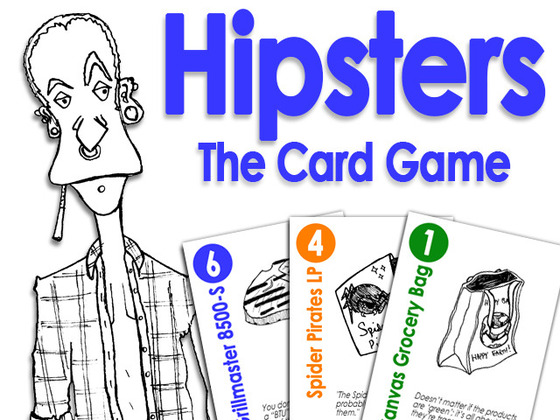
Today, I launched my first ever Kickstarter Campaign for Hipsters: The Card Game. As much as I'd like to toot my own horn, I couldn't have come this far without a good friend and business partner (Matthew).
If you check out my last post, you’ll see some images/ideas from early
development. Since then, Matthew and myself have been tirelessly iterating,
arguing, and inking tiny pictures. The
result is a 59-card deck fully fleshed out in terms of characters and items,
and about 50 percent complete in terms of art.

Art, art, and more art
Now comes the long haul – the marketing push, the completion of the game art, and the continued development for some of our stretch goals. On any other project, right about now is when I’d be tugging at my collar and looking for the exit. But I find myself today pumped and entirely ready to do this thing.
As Hipsters is the first real collaborative effort I’ve been a part of (as a
writer, I tend to hide in the shadows and scurry behind large rocks when groups
or potential partners emerge into view), I've learned a thing or two
about the creative process in a collaborative environment, namely the numerous
benefits it’s provided so far. For one, argument is paramount. And it’s just as necessary (no more, no less),
than compromise. One benefit of working with a partner is that you can voice
your opinion outside of your own head, which – if you’re like me – ends up sounding a lot different than it does rattling around your skull.
Secondly, you have someone to either confirm or deny the value of your ideas.
If you know how to listen, it’s a huge help in side-stepping landmines and
cashing in on tiny gold mines (if you’ll forgive the stale metaphors there). Lastly, if your ideas do genuinely suck, you've got someone to help you pick up the slack.
Check out a quick look at the game in action.
I can honestly say I would not have launched this project were I working alone. Sure, I might have had the idea and pushed it a bit, but it likely would have been stuck on a previous, sub-par iteration, and I seriously doubt I would have remained focused enough to power through over these past two months to produce as much content – and as focused content – as we have together.
So yeah, here we are – 29 days to go and tons of work to do. In the next month I’ll be drawing, writing, celebrating, despairing, and most definitely arguing. As of the time of this post, we have only 6 donors and are at 3% of our final goal. I don’t know if we’ll get there –I’ll do everything I possibly can to see that we do, but as of right now, I have no guarantee.
The only thing I do know is that this project won’t be my last collaboration.
Thanks for reading, and be sure to check out our Kickstarter!
Saturday, September 15, 2012
Hipsters: The Card Game
I wanted to take some time today to talk about a project I've been working on for the past few months with my good friend and colleague Matthew Gravelyn. It's not a piece of fiction or an essay or a script - it's a game; Hipsters: The Card Game, to be specific.

What is Hipsters? It's a 2-4 player game in which players race to build a hipster character for cred (points). You can win by making a raw vegan academic hipster who carries old chicken drumsticks and a cheap six-pack of Schitz beer in canvas bags. Or you can win with an cappuccino-sipping grungeling who's finishing up his master's thesis in between bouts of panhandling for drug money or gnawing on candy necklaces. Or maybe your particular style is looking down your nose at mainstream lackeys with unsophisticated music preferences and pouring buckets fake blood on fur-wearers while secretly hiding the smooth jazz collection stored beneath the driver's seat of your minivan.
You get the idea.
At its heart I think Hipsters is actually playing with some big questions. There's a kind of uncanny intangibility as to what a hipster really is, and this game takes that somewhat uncomfortable conversation and runs with it at full speed. In a way, it's a game about defining that which has no real definition. It's a game about forming an incongruous identity and rejoicing in the resulting ironies.
It's also supposed to be fun, quick, and humorous, if you're not into the whole identity crisis convo.

Mr. Gravelyn and myself are all but done finalizing the 59 cards that will constitute the Hipsters deck - we've just got to settle on some final items for our four hipster archetypes (Academic, Activist, Elitist, and Grungeling). The rules are all but completed too, though we plan on cementing those at our upcoming play test event at The Raygun Lounge (courtesy of Gamma Ray Games) in Seattle on October 7th. If you live in Seattle, we'd love to see you there.
For more info on development (and eventually availability) for Hipsters: The Card Game, please check out our Facebook and Twitter pages.
Oh, and if this made you chuckle, grimace, or otherwise change your facial expression, please do us a favor and share this page with a friend (I would insert a smiley here, but I'm far too hip to do so).
For more info on development (and eventually availability) for Hipsters: The Card Game, please check out our Facebook and Twitter pages.
Oh, and if this made you chuckle, grimace, or otherwise change your facial expression, please do us a favor and share this page with a friend (I would insert a smiley here, but I'm far too hip to do so).
Subscribe to:
Posts (Atom)